Friday, November 4, 2011
THE EAST IS RED #24 – A CHINESE GHOST STORY Then and Now
by Lisa Morton
In the history of Hong Kong cinema, 1986 just may go down as the finest year ever, with three landmark films – the triad thriller A Better Tomorrow, the feminist period action extravaganza Peking Opera Blues, and the wildly kinetic A Chinese Ghost Story – released that year. Even more amazing is that all three of those films had the same producer: Tsui Hark. Tsui officially directed only one – Peking Opera Blues – but his imprimatur is certainly all over the other two; even though A Better Tomorrow was director John Woo’s breakout hit, and A Chinese Ghost Story was credited to frequent Tsui collaborator Ching Siu-tung, there’s no question that Tsui was heavily involved with the direction of both, especially Ghost Story, which became a major worldwide hit for Tsui and for Hong Kong cinema. Tsui went on to produce two sequels to A Chinese Ghost Story, and in 1997 he even produced an animated version of the tale.
Like many other Hong Kong fantasy films, A Chinese Ghost Story was taken from a book called Strange Stories from a Chinese Studio, a 17th-century collection of fairy tales about haunted inns and animals that become people. Many of the stories center on a young scholar who stumbles on supernatural happenings and becomes embroiled in a forbidden love affair, and Tsui kept these elements for his 1986 adaptation, adding on more horror scenes and a plot involving the young scholar’s attempts to save his ghostly love from marriage to “Lord Black”, the king of Hell. As the young government official and the tragic ghost, Tsui and Ching cast two of the most astonishingly beautiful actors in Asian cinema: The late Leslie Cheung, and Taiwanese actress Joey Wang. A moment when Wang hides Cheung underwater and lavishes a long, slow-motion kiss on him as bubbles and flower petals float past is one of the great romantic moments of all Asian cinema.
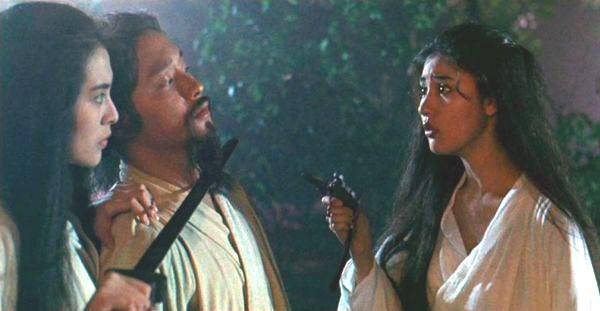
Now, in 2011, as Chinese and Hong Kong filmmakers have followed their American counterparts and begun to mine their cinematic past for remake gold, A Chinese Ghost Story has finally been reincarnated¸ although without the involvement of Tsui Hark. This time it’s director Wilson Yip at the helm, fresh off his success with the martial arts dramas Ip-man and Ip-man 2, directing unknowns Yu Shao-qun and Liu Yi-fei in the Leslie Cheung and Joey Wang roles; however, this version also throws in not one but two Taoist demon hunters, including Yan – played by popular Hong Kong leading man Louis Koo – who is also in love with the ghost girl.
This new version – which we’ll hereafter refer to as ACGS2011 – can’t help but pale by comparison to the neo-classic original, but it bears just enough resemblance to the original that fans of ACGS1986 will have a hard time letting it stand or fall on its own. It begins promisingly, with an extended flashback showing how the young Yan fell in love with the supernatural Siu Sin (who is referred to as a demon here); they finally part when he realizes that a demon-hunter and a demon can’t stay together.
Years later, a young government official, Ning, arrives to assist an isolated town suffering from a severe drought. Ning journeys with a gang of convict laborers to a mountainside temple, where he finds a well that could provide the town with water. Unfortunately, he also finds a pack of beautiful and seductive demons who murder the convicts and attack him. He barely escapes, thanks to the assistance of Siu Sin, and soon they begin to fall in love. Siu Sin reveals that she is being held captive by a thousand-year-old tree demon who is forcing lesser demons to kill for her. Things get even more complicated when Yan arrives, intent on finally killing the tree demon once and for all, and soon the other Taoist master also shows up.
If all that sounds confused and overly complicated…well, it is. Plotting is hardly the strength of either version of ACGS, but at least the Tsui/Ching original kept things moving forward quickly with a non-stop barrage of edits and images, not least of which was a night-time pursuit through a forest by a giant tongue. The new ACGS falters badly in the middle, spending far too much time on chatter instead of chills. Where the original had a delightfully spooky interlude involving Leslie narrowly escaping the clutches of stop-motion animated zombies, this one has Siu Sin and Ning hiding out in a deserted building and…well, talking. And talking. Call me shallow, but in a movie like this I’ll take goofy-looking zombies any day over the hero’s melancholic ramblings about his childhood.
There are certainly plenty of lovely images in ACGS2011, though (my favorite is a sequence in which the tree demon traps Koo in a literal sea of leaves, and he finally stops fighting and lets himself float atop the leaf-waves), and lots of nods to both the original film and other Tsui Hark movies as well (a pair of giggling snake demons are obviously an homage to Tsui’s Green Snake). The actors are all capable, if none begin to capture the luminescent star appeal of Cheung and Wang; the dependable Koo comes off best¸ making his gruff Taoist warrior both stalwart and funny (although no one could touch actor Wu Ma’s delirious drunken Taoist from the original ACGS). There are also some decent fight scenes and a few lovely sets; the score is fairly typical for a big modern Chinese historical epic these days, hardly comparable to James Wong and Romeo Diaz’s lovely songs and soundtrack from ACGS1987. Unfortunately, there’s nothing here to top the original’s final battle in Hell, but maybe the producers of ACGS2011 thought it best to simply not even try.
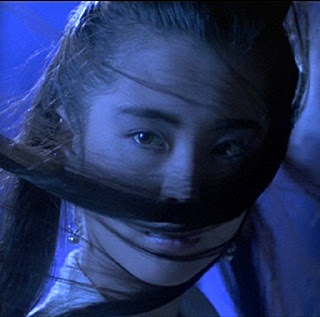
Overall, I’d probably only recommend the new ACGS to fans of the original, who will be entertained by the in-jokes and hat-tips (including the use of the original film’s main song). For newcomers looking to make an entry into the world of Chinese horror/fantasy films, though…trust me and stick to the original. I re-watch it every so often, and thanks in part to Tsui and Ching’s deft blending of horror, humor and romance, and the presence of the two stars, it still holds up splendidly. I wish I could say I’d be re-watching the new ACGS a quarter-of-a-century from now, but somehow it seems doubtful.
--Lisa Morton
Movies Worth Googling: Strange Movie Reviews by Jenny Orosel
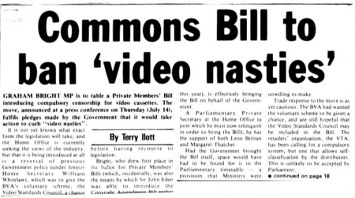
Save Me From Myself: Video Nasties of the UK
I’m a new mom. Like, I could count it in hours new (although it would be a lot of hours). Protecting my kid has been in the back of my mind for a while now. But I’ve also seen people go way overboard. Let’s face it, there’s a point where we go beyond protecting the kids and saving us from ourselves. For that, one needs look no further than the “Video Nasties” phenomenon in the UK of the 80s.
In the late 80s, videotape players were multiplying in homes everywhere. For those hit by the failing economy of Britain, a wise move was to open a video rental store. They were a quick business to set up, and with very little overhead, someone could quickly establish a successful business. At the same time, the major studios were hesitant to embrace this new home viewership technology, fearing piracy would ruin their profit margin. To fill the gaps in the market, independent and micro studios began releasing their grindhouse and direct-to-video fare, usually low-budget horror. To make this complete, let’s add a socially conservative climate to the UK, and a woman named Mary Whitehouse whose personal mission was to clean up the culture and you have a perfect storm for misguided censorship.
Whitehouse, at the time heading the National Viewers’ and Listeners’ Association (after heading a campaign to rid Britain of the evil “Doctor Who” series) was the public mouthpiece of a movement to ban horror and violent movies from video store shelves. Her claim was that, despite being rated from theatrical releases, small children could get their hands on movies like THE EXORCIST or SS EXPERIMENT CAMP. At first, the decisions of what titles to pull and what not to were left to the local police departments. While great in theory, in practice it was a nightmare. One town would be fine with video stores stocking FACES OF DEATH, while even two blocks away, they would be confiscating BEST LITTLE WHOREHOUSE IN TEXAS thinking that, since it sounds like a porno title, it must be. A movie legal on one side of the street would get you arrested on the other. A central list needed to be made. Hence, the Video Recordings Act of 1984 was born.
Any film wanting to get a home video release had to be certified through the British Board of Film Certification, even if the Board had previously approved it for theatrical release. Then, one of three things would happen: it would pass, edits would be requested, or certification would be denied outright. It was illegal to release a video without certification. The studio behind THE EXORCIST didn’t even submit the film, and its viewing in the home was illegal until 1999. When all was said and done, 39 titles appeared on the list of banned “Video Nasties” which all had been successfully prosecuted.
There were some obviously violent movies on the list. FACES OF DEATH is the hardest to defend. For those unfamiliar, it was filmed in a similar vein to MONDO CANE but instead of cultural references, it portrayed scenes of death. It’s estimated that forty percent of it was recreations and “faked”. That means over half of the movie contains real-life death. To be fair, a large chunk of that is the death of animals, but there are still some scenes of human death. People hear of FACES OF DEATH being on the list and the usual reaction is an understanding nod.
The majority of the list was filled with what could be classified as “splatterpunk”, movies with high body counts or countless pints of blood. DRILLER KILLER, CANNIBAL HOLOCAUST, LAST HOUSE ON THE LEFT. Nobody can deny the intense violence of those movies, and you certainly won’t hear people say that children would be fine watching them. But then there were movies included like EVIL DEAD, Dario Argento’s INFERNO and ANDY WARHOL’S FRANKENSTEIN (aka FLESH FOR FRANKENSTEIN). Sure, there is more violence in those flicks than, say, WILLY WONKA AND THE CHOCOLATE FACTORY. But the violence is not the purpose for their existence and their fame. EVIL DEAD was almost as much a comedy as horror, INFERNO was dripping with visual style and FRANKENSTEIN was a bizarre experiment in art-house horror and 3-D craziness (only the R-rated version was released in 3-D. There was a cut released as an X, but director Paul Morrissey decided that full frontal male nudity was too much to see popping off the screen). Yet, because these movies were also not appropriate for children, they were banned out of fear they would end up in kids’ hands. They had already been rated for theatrical release and if the ratings were followed, they would not end up in the hands of children. But a survey was done among grammar school children and they were presented with a list of Video Nasties and more than half the kids stated they had seen them. This was used as proof that the video stores or parents couldn’t be trusted to keep the children away from these tapes. Later on, one of the UK newspapers did a follow-up with the kids and it turns out that almost all of them will say they’d seen a movie more to feel “cool” around their peers and had actually not seen them. Yet it was still a decade and a half before the Video Recordings Act was altered.
The enthusiasm for banning these nasty videos grew and soon it wasn’t just splatterpunk and torture porn being banned. Sam Peckinpah’s STRAW DOGS was pulled from the shelves. This movie has been an influence on directors for years to come. Is there violence? Sure. But the point of the movie is to show how violence can negatively affect even the biggest pacifist. That is hardly exploitive, but the mere existence of the violence was enough for the board to turn up their noses. Similarly, Andrzej Zulawski’s POSESSION was banned as well. This surreal examination of the dissolution of a marriage through the dissolution of the psyche has some violence, but not nearly as much as most Australian Rules Football games. It won awards at Cannes and even scored the Cesar Award (the French equivalent of the Oscar). Yet nobody, not even the most responsible adult, was allowed to view it in the UK.
In 2009, the Video Recordings Act was finally updated. It allowed for an 18 rating and most of the Video Nasties eventually saw release, either in edited versions or fully uncut. However, there is still a law saying a movie must be submitted to the BBFC before the DVD can legally be sold there. Currently there is a campaign for a “Voluntary 18” for small distribution companies who cannot afford to go through the certification process, where they would voluntarily accept the highest rating without having to submit to the bureaucratic process. So far it has not passed.
Should any movies be on a banned list? Personally, I won’t be thrilled if my daughter came home with FACES OF DEATH. But you won’t see me telling another adult not to watch it. And you certainly won’t hear me calling to make it illegal; not because of any great FACES OF DEATH love, but because once we set that precedent you never what great work of art might follow close behind.
WHERE TO FIND THE MOVIES: In the US, none of the Video Nasties were ever banned. In the UK, eleven of the original 39 are still banned:
THE BEAST IN HEAT
BLOOD RITES
FIGHT FOR YOUR LIFE
FOREST OF FEAR
FROZEN SCREAM
GESTAPO’S LAST ORGY
LOVE CAMP 7
MARDI GRAS MASSACRE
NIGHTMARE MAKER
WEREWOLF AND THE YETI
WOMEN BEHIND BARS
However, with the advent of the internet, I dare say that, if you want to see one of the movies, there will be a way one way or another.
--Jen Orosel
I’m a new mom. Like, I could count it in hours new (although it would be a lot of hours). Protecting my kid has been in the back of my mind for a while now. But I’ve also seen people go way overboard. Let’s face it, there’s a point where we go beyond protecting the kids and saving us from ourselves. For that, one needs look no further than the “Video Nasties” phenomenon in the UK of the 80s.
In the late 80s, videotape players were multiplying in homes everywhere. For those hit by the failing economy of Britain, a wise move was to open a video rental store. They were a quick business to set up, and with very little overhead, someone could quickly establish a successful business. At the same time, the major studios were hesitant to embrace this new home viewership technology, fearing piracy would ruin their profit margin. To fill the gaps in the market, independent and micro studios began releasing their grindhouse and direct-to-video fare, usually low-budget horror. To make this complete, let’s add a socially conservative climate to the UK, and a woman named Mary Whitehouse whose personal mission was to clean up the culture and you have a perfect storm for misguided censorship.
Whitehouse, at the time heading the National Viewers’ and Listeners’ Association (after heading a campaign to rid Britain of the evil “Doctor Who” series) was the public mouthpiece of a movement to ban horror and violent movies from video store shelves. Her claim was that, despite being rated from theatrical releases, small children could get their hands on movies like THE EXORCIST or SS EXPERIMENT CAMP. At first, the decisions of what titles to pull and what not to were left to the local police departments. While great in theory, in practice it was a nightmare. One town would be fine with video stores stocking FACES OF DEATH, while even two blocks away, they would be confiscating BEST LITTLE WHOREHOUSE IN TEXAS thinking that, since it sounds like a porno title, it must be. A movie legal on one side of the street would get you arrested on the other. A central list needed to be made. Hence, the Video Recordings Act of 1984 was born.
Any film wanting to get a home video release had to be certified through the British Board of Film Certification, even if the Board had previously approved it for theatrical release. Then, one of three things would happen: it would pass, edits would be requested, or certification would be denied outright. It was illegal to release a video without certification. The studio behind THE EXORCIST didn’t even submit the film, and its viewing in the home was illegal until 1999. When all was said and done, 39 titles appeared on the list of banned “Video Nasties” which all had been successfully prosecuted.
There were some obviously violent movies on the list. FACES OF DEATH is the hardest to defend. For those unfamiliar, it was filmed in a similar vein to MONDO CANE but instead of cultural references, it portrayed scenes of death. It’s estimated that forty percent of it was recreations and “faked”. That means over half of the movie contains real-life death. To be fair, a large chunk of that is the death of animals, but there are still some scenes of human death. People hear of FACES OF DEATH being on the list and the usual reaction is an understanding nod.
The majority of the list was filled with what could be classified as “splatterpunk”, movies with high body counts or countless pints of blood. DRILLER KILLER, CANNIBAL HOLOCAUST, LAST HOUSE ON THE LEFT. Nobody can deny the intense violence of those movies, and you certainly won’t hear people say that children would be fine watching them. But then there were movies included like EVIL DEAD, Dario Argento’s INFERNO and ANDY WARHOL’S FRANKENSTEIN (aka FLESH FOR FRANKENSTEIN). Sure, there is more violence in those flicks than, say, WILLY WONKA AND THE CHOCOLATE FACTORY. But the violence is not the purpose for their existence and their fame. EVIL DEAD was almost as much a comedy as horror, INFERNO was dripping with visual style and FRANKENSTEIN was a bizarre experiment in art-house horror and 3-D craziness (only the R-rated version was released in 3-D. There was a cut released as an X, but director Paul Morrissey decided that full frontal male nudity was too much to see popping off the screen). Yet, because these movies were also not appropriate for children, they were banned out of fear they would end up in kids’ hands. They had already been rated for theatrical release and if the ratings were followed, they would not end up in the hands of children. But a survey was done among grammar school children and they were presented with a list of Video Nasties and more than half the kids stated they had seen them. This was used as proof that the video stores or parents couldn’t be trusted to keep the children away from these tapes. Later on, one of the UK newspapers did a follow-up with the kids and it turns out that almost all of them will say they’d seen a movie more to feel “cool” around their peers and had actually not seen them. Yet it was still a decade and a half before the Video Recordings Act was altered.
The enthusiasm for banning these nasty videos grew and soon it wasn’t just splatterpunk and torture porn being banned. Sam Peckinpah’s STRAW DOGS was pulled from the shelves. This movie has been an influence on directors for years to come. Is there violence? Sure. But the point of the movie is to show how violence can negatively affect even the biggest pacifist. That is hardly exploitive, but the mere existence of the violence was enough for the board to turn up their noses. Similarly, Andrzej Zulawski’s POSESSION was banned as well. This surreal examination of the dissolution of a marriage through the dissolution of the psyche has some violence, but not nearly as much as most Australian Rules Football games. It won awards at Cannes and even scored the Cesar Award (the French equivalent of the Oscar). Yet nobody, not even the most responsible adult, was allowed to view it in the UK.
In 2009, the Video Recordings Act was finally updated. It allowed for an 18 rating and most of the Video Nasties eventually saw release, either in edited versions or fully uncut. However, there is still a law saying a movie must be submitted to the BBFC before the DVD can legally be sold there. Currently there is a campaign for a “Voluntary 18” for small distribution companies who cannot afford to go through the certification process, where they would voluntarily accept the highest rating without having to submit to the bureaucratic process. So far it has not passed.
Should any movies be on a banned list? Personally, I won’t be thrilled if my daughter came home with FACES OF DEATH. But you won’t see me telling another adult not to watch it. And you certainly won’t hear me calling to make it illegal; not because of any great FACES OF DEATH love, but because once we set that precedent you never what great work of art might follow close behind.
WHERE TO FIND THE MOVIES: In the US, none of the Video Nasties were ever banned. In the UK, eleven of the original 39 are still banned:
THE BEAST IN HEAT
BLOOD RITES
FIGHT FOR YOUR LIFE
FOREST OF FEAR
FROZEN SCREAM
GESTAPO’S LAST ORGY
LOVE CAMP 7
MARDI GRAS MASSACRE
NIGHTMARE MAKER
WEREWOLF AND THE YETI
WOMEN BEHIND BARS
However, with the advent of the internet, I dare say that, if you want to see one of the movies, there will be a way one way or another.
--Jen Orosel
The Hand that Reads #3: Turning Nothing into Something
by JW Schnarr
Recently a discussion on a small press forum got me thinking about some of the dynamics involved in the small presses, and how I've made them work for me over the years. This is something I picked up on some years ago, and it really is a no-brainer. I'm actually amazed more people haven't caught on to it.
In the last ten years or so I've seen magazines replaced by the rise of the small press anthology - books often put together by Indie writers dabbling in the waters of the publishing world (they are vast and deep, believe me, I've done it myself).
These books don't usually pay much, and they don't usually sell much. Nobody makes any money off them. The writer adds a publishing credit to his or her resume, the publisher goes out of business, and the circle of life continues in grand fashion. These books are often looked down on by more established writers, and the professional industry at large almost completely ignores them.
Years ago I gave up on 4TL and token payment markets, insisting on what's generally considered to be "semi-pro" payment for work sold. But even the 1-3 cents a word I usually sell for is really a joke compared to what I make writing professionally. The money is merely to settle my own piece of mind that my work has value and other people believe that as well.
But there's an easy way for a writer to ramp up the value of a story while gaining exposure AND helping out the publishers who are going broke putting these books out. Ready? It's really groundbreaking stuff.
Buy some books yourself, and sell them.
Mind blowing, right?
Now there's a catch: you need to submit to publishers who offer trade discounts to authors (40% or more), and honestly if they're not doing that, they really need to learn something about marketing, don't they? The discount is the same they'd give to a bookstore, and believe me, you, as a contributor, are going to sell more books for them than any single bookstore.
Let's do some easy math. The publisher gives you a book for say, $9 or $10. If you order 10, you might even get a deal on shipping. But if not, let's say your investment bounces up to 11 bucks per book. (S&H gets cheaper per piece the more you order). Now, go sell the book for $15 to $16 (a common Indie book price), and pocket the difference. Do it 10 times and add $40 to $50 to the value of the story you wrote. When you've sold out, put another order in.
The economics of this setup are perfect for everyone. The retail cost for 10 books might be $150. Broken down, that's $50 for the printer, $50 for the publisher, and $50 for a certain enterprising contributor. If it was originally a 4TL market, congratulations, you just graduated to paid status. If you were getting a token or semi-pro payment, well, you might have just added a cent or three to the value of your story. Over the course of several years, that little 4TL contribution could eventually generate hundred of dollars in revenue for you and the publisher. And it will continue to generate revenue as long as you keep pushing it.
Can't afford a table at your local Con? How about a craft fair? How about a flea market? Hell, I've sold books at the pub. I've sold them at weddings and funerals. Believe me, I'm not bragging about funeral sales. But there was drinking involved, and they were insistent. I keep boxes of books in the trunk of my car because you never know when the subject is going to come up. When somebody says, "do you have any copies of your book?" you ALWAYS want to say yes.
As for the tables, get a handful of these anthologies working for you and you're going to look like a REAL WRITER with a table full of books containing your work. Guess what? You ARE a real writer.
Too often Indie writers feel that support for small press means hanging out on forums and networking, or they mistakenly believe cash should only ever flow one direction - from the publisher to the writer (that saying actually means something else entirely). Real support for Indie markets grows out of mutual work on behalf of the publisher and the writer to reach target markets.
Too many Indie writers sell a story and then write off the book it appears in forever, moving on to another story without another thought. This is one way to do it, but in my opinion it's a very narrow-minded view. It's missed opportunity.
So next time you sell a story, bite the bullet and order a handful of copies. It helps you, and it helps the publisher stay in business. A low paying market may not be such a big deal to you or your online writer buddies, but it is a big deal indeed to people who have never written a story, who are impressed that you have been published, and are interested in hearing about your work, buying a signed copy, and reading what you've created. Hell, they may even LIKE it. They might come looking for more next time you have a story to sell. And I guarantee you'll love signing the book and pocketing some cash.
"JW Schnarr is a writer from Claresholm, AB. He works as a reporter/photographer by day and a horror writer/publisher by night. He is the author of "Things Falling Apart" and Alice & Dorothy. JW can be reached at jwschnarr@hotmail.com
Recently a discussion on a small press forum got me thinking about some of the dynamics involved in the small presses, and how I've made them work for me over the years. This is something I picked up on some years ago, and it really is a no-brainer. I'm actually amazed more people haven't caught on to it.
In the last ten years or so I've seen magazines replaced by the rise of the small press anthology - books often put together by Indie writers dabbling in the waters of the publishing world (they are vast and deep, believe me, I've done it myself).
These books don't usually pay much, and they don't usually sell much. Nobody makes any money off them. The writer adds a publishing credit to his or her resume, the publisher goes out of business, and the circle of life continues in grand fashion. These books are often looked down on by more established writers, and the professional industry at large almost completely ignores them.
Years ago I gave up on 4TL and token payment markets, insisting on what's generally considered to be "semi-pro" payment for work sold. But even the 1-3 cents a word I usually sell for is really a joke compared to what I make writing professionally. The money is merely to settle my own piece of mind that my work has value and other people believe that as well.
But there's an easy way for a writer to ramp up the value of a story while gaining exposure AND helping out the publishers who are going broke putting these books out. Ready? It's really groundbreaking stuff.
Buy some books yourself, and sell them.
Mind blowing, right?
Now there's a catch: you need to submit to publishers who offer trade discounts to authors (40% or more), and honestly if they're not doing that, they really need to learn something about marketing, don't they? The discount is the same they'd give to a bookstore, and believe me, you, as a contributor, are going to sell more books for them than any single bookstore.
Let's do some easy math. The publisher gives you a book for say, $9 or $10. If you order 10, you might even get a deal on shipping. But if not, let's say your investment bounces up to 11 bucks per book. (S&H gets cheaper per piece the more you order). Now, go sell the book for $15 to $16 (a common Indie book price), and pocket the difference. Do it 10 times and add $40 to $50 to the value of the story you wrote. When you've sold out, put another order in.
The economics of this setup are perfect for everyone. The retail cost for 10 books might be $150. Broken down, that's $50 for the printer, $50 for the publisher, and $50 for a certain enterprising contributor. If it was originally a 4TL market, congratulations, you just graduated to paid status. If you were getting a token or semi-pro payment, well, you might have just added a cent or three to the value of your story. Over the course of several years, that little 4TL contribution could eventually generate hundred of dollars in revenue for you and the publisher. And it will continue to generate revenue as long as you keep pushing it.
Can't afford a table at your local Con? How about a craft fair? How about a flea market? Hell, I've sold books at the pub. I've sold them at weddings and funerals. Believe me, I'm not bragging about funeral sales. But there was drinking involved, and they were insistent. I keep boxes of books in the trunk of my car because you never know when the subject is going to come up. When somebody says, "do you have any copies of your book?" you ALWAYS want to say yes.
As for the tables, get a handful of these anthologies working for you and you're going to look like a REAL WRITER with a table full of books containing your work. Guess what? You ARE a real writer.
Too often Indie writers feel that support for small press means hanging out on forums and networking, or they mistakenly believe cash should only ever flow one direction - from the publisher to the writer (that saying actually means something else entirely). Real support for Indie markets grows out of mutual work on behalf of the publisher and the writer to reach target markets.
Too many Indie writers sell a story and then write off the book it appears in forever, moving on to another story without another thought. This is one way to do it, but in my opinion it's a very narrow-minded view. It's missed opportunity.
So next time you sell a story, bite the bullet and order a handful of copies. It helps you, and it helps the publisher stay in business. A low paying market may not be such a big deal to you or your online writer buddies, but it is a big deal indeed to people who have never written a story, who are impressed that you have been published, and are interested in hearing about your work, buying a signed copy, and reading what you've created. Hell, they may even LIKE it. They might come looking for more next time you have a story to sell. And I guarantee you'll love signing the book and pocketing some cash.
"JW Schnarr is a writer from Claresholm, AB. He works as a reporter/photographer by day and a horror writer/publisher by night. He is the author of "Things Falling Apart" and Alice & Dorothy. JW can be reached at jwschnarr@hotmail.com
Servante of Darkness #4: Grotesques and the Southern Gothic
Trailer Park Noir (2011) by Ray Garton
Reviewed by Anthony Servante
Welcome to the Darkness, dear readers. This month we take a look at the underside of the American Dream, that vile village known as the trailer park. We shall investigate the people who populate such a place, through the eyes of Ray Garton, grotesque characters like those one would find in the Southern Gothic novel, in works by the likes of Robert E. Howard (Pigeons from Hell), William Faulkner, Erskine Caldwell, Flannery O’Connor, and Tennessee Williams.
“Southern Gothic” novels would often have macabre characters in exaggerated locales. According to Philip Thomson in his work, The Grotesque (1972) Methuen & Co. Ltd., the characters are usually considered ‘grotesque’ if they induce both empathy and antipathy. Ray Garton’s Trailer Park Noir (2011) meets this definition with its slew of odd characters and urban blithe setting. But, instead of a post-Civil War South, Garton places his characters in a trailer park, the underbelly of middle-class America. In essence, we could call the noir novel, a Southern California Gothic.
The story takes place in a Riverside, California trailer park where sleazy characters reside and the comings and goings of the police would not be unexpected. The characters are distorted tragic figures, traversing the normal and abnormal qualities of disharmony with “unresolved conflicts of work and response” (Thomson). In other words, we like the characters at the same time that we dislike them. There are no heroes here to cheer. We can only hope for some redemption to overcome the repulsion. We cringe as the trailer park characters go from bad to worse. So, let’s delve into our cast of characters from the Riverside Mobile Home Park and see how they work and respond to their dark situations.
Typical of the “Southern Gothic” is the story’s reliance on a character with a childlike mind but corrupted body or soul. William Faulkner's innocent is the mentally handicapped Benji from The Sound and the Fury; Carson McCullers’ the deaf-mute John Singer in The Heart is a Lonely Hunter. Ray Garton has Kendra Dunfy, a twelve year old girl stuck in the body of a seductive young woman, sixteen going on twenty-six. Kendra longs to do “naughty” things, as she is only beginning to learn what “naughty” even means. Boys her own age are confused by her but men, both married and single, are drawn to her with lewd temptations, both physical and mental, in fantasy and plan.
Marcus Reznick sees in the beautiful nubile girl the young wife he had his first sexual relations with since high school. Yet he grapples with his desires for this “retarded” teenager with a child’s mind, fighting off his temptations and erections by thinking of returning to his alcoholic ways. The loss of his wife to suicide, graphically described in the book, haunts the Private Investigator Reznick and had driven him to drink. Kendra reawakens the desires in him that he came to the trailer park to escape. Tension of tragic proportions ensues.
Steve Regent sees in Kendra’s photogenic sexuality his ticket to a bonanza on his pornography website, although he does not realize or possibly does not care that Kendra is underage, but he sizes her up as an easy mark because of her handicap. He allows his greed and lust to dictate his actions. He tricks the young girl into disrobing so that he can photograph her and plans to seduce her on video to satisfy his own desires and quench the lusts of his many website clients. Unlike Reznick, Regent does not seek to control or hide his ‘erections’ and a series of bad events is set in motion.
Kendra’s mother, Anna, becomes a stripper by night and a temp by day, opposing figures that create conflict with the raising of a daughter who also embodies conflicting personalities: child versus young woman. Anna vies to allow her daughter some independence accorded a sixteen year old girl, while worrying that the unsupervised girl may be in danger because her attractive features will draw in bad men. She even worries about her neighbor Reznick, whom she likes and trusts, but whom she promises to ‘kill’ should he deflower her daughter. No jury with a mother on it would convict her of murder, she reasons to herself. Her maternal instinct is murder.
Rose, Anna’s sister, often baby-sits Kendra and lectures her sister about her daughter’s sexuality and the risks she is taking by being a stripper. Rose tells Anna that Kendra would make a good stripper, that she has what men want to see. The sisters argue over the needless comparison of Anna’s voluptuous body to that of Kendra’s and Anna recalls how her parents never discussed such vulgar topics in their home. But Rose reminds her that in her own home, Rose speaks freely of sex to her own son and daughter, without realizing that she is merely leaving the impression that she may be a bit too liberal with her talk of sex with her pre-teen kids. Only confusion can ensue with the mixed messages her kids are receiving, much as Kendra’s own confusion drives the plot.
More grotesque characters abound in this noir novel.
Arnold Garvis, the corpse in Sherry and Andy’s trailer, has a “mom [who] is hooked on pills and his dad drinks and sees hookers. But they go to church every Sunday, so I guess it all ... evens out.” Muriel Snodgrass, park manager, “was a fat pasty-white woman with a big belly, but spindly legs that came like sticks out of the baggy blue shorts she wore. Her black-dyed hair – and a bad job, too – was a mess.” Linda Straight, Reznick’s client, learns her husband’s cheating on her with several women—an example of grotesque exaggeration and excess. Also, Reznick’s parents are killed by a robber soon after he loses his wife—more excess. Senator Wilson Garvis is “big on morals and family values and prayer in schools”, while hiring hookers in his spare time. Monica, the Goth girl, and seven year old Valerie—both already wise to the ways of sex—try to initiate Kendra into being naughty. And on and on the list goes. We have drug addicts, wife beaters, perverts, murderers, rapists, abortionists, many of whom are good church-goers or come from good families (perhaps with the exception of Steve Regent, an irredeemable scoundrel similar to the carpetbaggers infesting the fallen South).
Ray Garton has gathered a cast of characters that could easily fit into a Southern Gothic: grotesque figures, inside and out, morally and physically. Trailer Park Noir (I have found myself mistakenly typing Trailer ‘Trash’ Noir a number of times—just to show you how seedy these characters are) echoes the “trashy” characters one would expect to find in gothic novels of the old South, where the Civil War turned the grand society of civility and manners into a wasteland of bitter losers trying in vain to hold onto their former dignity. Where once there was great light, there now fell a vast darkness. Garton tells us, “When I wrote Trailer Park Noir, I wanted to capture the feeling of Shady Hill Trailer Park that I experienced as a little boy and then reveal the dark underside. But somehow, that eluded me. It was overshadowed by what the park had become.” And what it had become was a Southern California Gothic.
(Visit Ray Garton at his official website)
--Anthony Servante
It Came From the Back Issue Bin! #22: Toronto After Dark Film Festival 2011
by Jason Shayer
I’m taking a well deserved break from comic books this month after review all of DC’s New 52 comics last month. While I didn’t get a press pass this year for the Toronto After Dark Film Festival, the organizers were kind enough to comp me a couple of passes to two of their films: Monster Brawl and VS.
Before moving onto my reviews, I wanted to make note of the new venue for the festival, The Toronto Underground Cinema. I was a bit disappointed with the new venue and not really so much for the theatre itself, which is great, but I found the location odd as it was in the basement of a dying condo building along Spadina Avenue. The area wasn’t as vibrant as the trendy student-focused neighbourhood that surrounded the previous venue, The Bloor Cinema, and seriously lacked some good restaurants.
Monster Brawl (2011)
From the film’s Facebook page:
“Set in the tradition of a Pay-Per-View main event, comes a grotesque and hilarious fight to the death featuring a cast of eight classic combatants in all. Along with their colorful managers, these Monsters compete in visceral bloody combat in the ring to determine the most powerful monster of all time. Monster Brawl stars comedian Dave Foley (Kids in the Hall, Bugs Life, Despicable Me), wrestling icons Jimmy Hart - The Mouth of the South, Kevin Nash, revered MMA referee Herb Dean, Robert Maillet (300, Sherlock Holmes, The Immortals), Art Hindle (Porky's, Black Christmas) and the voice of horror legend and Call of Duty narrator Lance Henriksen (Aliens, Terminator). Monster Brawl is sure to be a cult classic in the making!”
Monster Brawl delivered exactly what was advertized, but unfortunately nothing more. The story’s linear progression got a bit tiring and at times painfully predictable. What lies at the center of its weakness was the event-style plot. It really needed its own story-driven plot, even something as simple as having a couple of kids sneak on to the set and have them get into trouble would have giving the audience something to identify with beside the monsters. I also found that it wasn’t feasible to fit in the appropriate amount of screen time for each monster to establish that connection the movie maker was hoping would help create that Pay-Per-View event feel and generate participation for the audience.
VS. (2011)
Four Super Heroes find themselves abducted by their Arch Nemesis and are forced to compete in a series of challenges in order to save an abandoned town full of kidnapped innocent civilians.
Unfortunately, the trailer was exceptionally well done and really didn’t reflect the overall effort behind the movie. While the premise was intriguing, the execution failed on several levels. The movie’s creator wanted to tell a superhero story without their powers. Keeping in mind that this was an Indy comic book movie, having the heroes stripped of their powers seemed to be a bad decision. Perhaps regaining them at some point would have added a bit more intensity and reward and might have helped drive the creator’s point across more effectively.
The dialog was painful, even for a lifelong comic book reader like myself. Apparently this movie was shot over 10 days and written in a week, and it showed. The flashback sequences were well crafted, but came too late as you really didn’t feel for these characters as they faced their deathtraps.
This sampling of films wasn’t enough for me to gage the quality at this year’s Toronto After Dark Film Festival. From other accounts, the overall quality of the Festival was quite good, even better than last year. I’m already looking forward to next year.
--Jason Shayer
Graphic Horrors
By Brian M. Sammons
Ok, not much in the way of horror games this month, although I have two ginormous titles to discuss. One broke the sales records of…well everything. Books, movies, music, even other video games; they were all blown away by this 800 pound gorilla, but does huge sales automatically translate into a great game?
As for the other game, that one sold like gangbusters too, and it does have ghosts, walking skeletons, demons, and all sorts of monsters in it, so while not horror per say, it does have some of the flavor. Oh and it also happens to be the hands down winner for my Game of the Year and one of the best video games of all time. Yeah, that’s not just hyperbole, it’s a fact. Or at the very least, that’s my highly educated opinion. And since I don’t believe in saving the best for last, I’m going to start with that amazing game now and prove it to you.
THE ELDER SCROLLS V: SKYRIM, by Bethesda Softworks, Rated M, PC, PS3, Xbox 360
This is not only my Game of the Year for 2011, but it honestly could be the best game of this generation of consoles. Never before has a game world been so fully and completely realized. Never before have you been given so many options on how to play, both in what type of character you want to truck around as, but where you want to go in a huge, sprawling map filled with wonderfully realized and vastly different locations. SKYRIM is easily the greatest sandbox game ever, blowing your mind with an almost limitless amount of choice and game play that seems to go on and on forever, if you want it to, or a main story line that can be rushed through in a couple of sittings if that’s your thing. However, if that is your thing, don’t bother with this game, it’s not for you. SKYRIM is meant to be savored, enjoyed, and experienced for days and days, perhaps months and months. If you are the type of gamer that loves to lose yourself in a RPG, then this game will do that for you like no other has done before.
The actual main story of SKYRIM is pretty straightforward fantasy fare. You play as one of a half dozen or so fantasy races, from cat and lizard people, to three different types of elves, and even a few human types from different parts of the kingdom. Even the ever present orc, usually resigned to just being sword fodder in games like these, is a race you can choose to play. Whomever you play as, you find yourself in the land of Skyrim, think of it as the home of Vikings as it is a very wild and often snowy place, but also a starkly beautiful land.
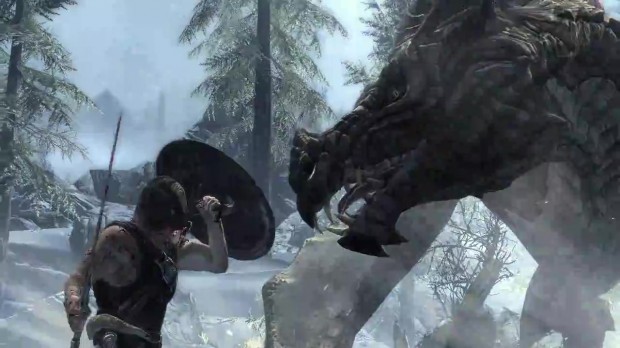
Your character is a “dragon born” which means that when you slay dragons you can absorb some of their power and then use it against your enemies by shouting at them in the mystical dragon language. The varieties of dragon powers you can learn are impressive, from the typical breathing fire thing to more neat tricks like slowing time or summoning a raging storm to hurl lightning bolts at your foes. And it’s a good thing you just came to Skyrim, as the dragons, long thought to be extinct, are starting to fly again in ever increasing numbers. It soon becomes your duty and destiny to find out what’s bringing the dragons back and to stop them before the whole world is lost to the flames.
And when I said before that this game was big, I meant it was freaking huge! There are so many side quests, miscellaneous adventures, and random bits of fantasy adventure goodness to explore that the creators of this game have said that to complete it all would take over 300 hours. Yes, I said 300 hours! And in these harsh economic times, that’s one hell of a bargain. If the 300 hour estimate is true, and so far I have yet to see anything even hinting that it’s not, and you bought this game at the usual price of $60 US, that translates into just twenty cents per hour of entertainment. No other video game has ever given you so much for so little, and that includes online multiplayer games that routinely soak you for new DLC map packs every three months or so.
But a whole lot of something, if bad, is still not a good thing. Thankfully SKYRIM is very good, damn near perfect, in so many ways.
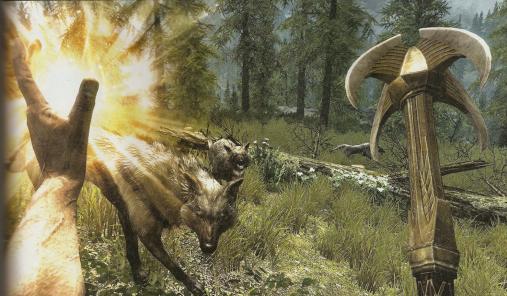
The way you play this game is wonderfully fresh and liberating as you don’t play a class, like a warrior or a wizard. Instead you get a bunch of skills and the ones you use more are the ones you will excel in. Do you like casting fireballs and bolts of ice at the bad guys? Then do so and soon you will be a better combat wizard than Harry Potter could ever hope to be. Do you like bashing things with big, intimidating weapons? Well just keep doing that and you’ll be a bigger badass than Conan ever was. Or do you prefer to be more subtle and sneaky? Then go ahead and play that way and you’ll be the slyest master thief in no time. This freedom also means there are no ends of the possibilities of what kind of heroic adventurer you want to play. Me, I’m a fireball chucking, great axe wielding, heavy armor wearing, death machine who can pick a mean lock and forge my own high-end weapons and armor and then enchant them to deal even more hurt to my enemies. Yeah, that’s role playing freedom the likes of which has never been realized so completely before. When this game tells you to play it however you want to, it actually means it.
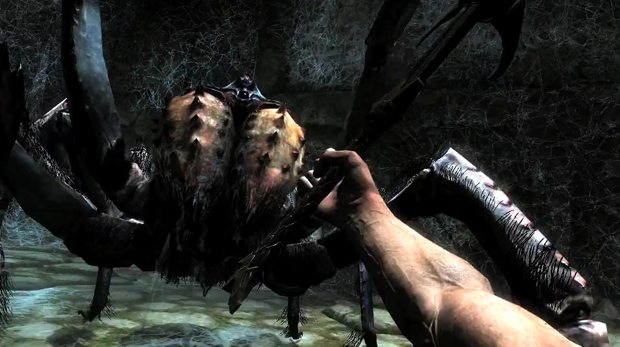
Then there is the world this great game is set it. Yes it is huge, but it is also beautiful and at times literally breathtaking. I cannot count the number of times I stopped doing whatever it was I was doing to look around at the scenery and all that was around me and was just floored by the detail and how amazing it all looked. One of the main reasons people play games like these is to see things they’ve never seen before and to adventure in a world of harsh beauty. It’s one of the things that made the LORD OF THE RINGS movies so memorable and its one of the things this game gets so very right. SKYRIM just looks great.
Now all this praise, while fully warranted, doesn’t mean that SKYRIM doesn’t have its share of foibles, boo-boos, and bugs. Thankfully such things are minor, but they’re still annoying. Currently there are some graphical glitches that keep the game from looking as good as it should. There were also a couple of bugs that all but halted two of the quests I was doing. Luckily they were non-essential side quests, but it was still very annoying. And yes, the game completely locked up on me in that sadly familiar Bethesda way three times. Yeah, that never makes me happy, but that sadly seems par for the course anymore. Then there were the occasional funny bits, like mammoths floating in air and objects, usually the dead bodies of your enemies, clipping into solid objects like walls and tables and becoming stuck that while not game breaking are still a bummer to experience. Perhaps my biggest gripe is not a bug but the many, and usual long, load times you get any time you transition from any outside location to an inside one, no matter how small the new location may be. However, that is a small price to pay for such a giant world to go adventuring it, and just the nature of the beast when it comes to sandbox games, so I try not to let it get to me too much.
In closing, there has never been a game, RPG or otherwise, as big, freeing, or fun as THE ELDER SCROLLS V: SKYRIM. I have thoroughly enjoyed every minute I’ve spent with it and I fully intend to spend a whole lot more in that wonderfully realized fantasy world, slaying dragons, climbing the highest mountains and delving the darkest dungeons. I just can’t get enough of this game and I can’t think of the last time I felt that way over anything, be it game, movie, book or other.
THE ELDER SCROLLS V: SKYRIM easily gets 5 dragon shouts that blast baddies to bits out of 5. If you get one video game this year, or even the next, make sure it is this game.
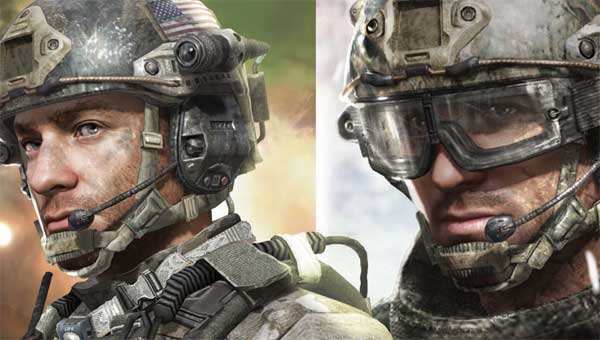
CALL OF DUTY: MODERN WARFARE 3, by Infinity Ward and Activision, Rated M, PC, PS3, Xbox 360
What more can be said about the MODERN WARFARE series that hasn’t already been said? If you know about this game at all then you know what it’s all about. Even if you’re not a gamer (then I’ve got to wonder what you’re doing reading this) chances are you still know all about MODERN WARFARE. Not only does the series continue to break sales records with every new installment, but it has had a mega dollar media blitz like nothing else ever. Hell, even my mom knows what this game’s all about and she’s never played a video game, ever. So with all that said the chances are very high that if you want this game, you’ve already got it and if you don’t care about CoD: MW3, there’s nothing I can say to change your mind. But hey, it’s my job to tell you about games, so I had better get to it.
The story of MW3 picks right up where the previous game ended, with the much loved character of “Soap” barely hanging on to life after an epic battle. As for the whole rest of the world, it is smack dab in the middle of World War 3! As with other CoD games, the action will jump around all over the globe and you’ll be playing as any number of solders and special operations bad asses. You’ll start in New York City but then quickly hop over to London, Paris, Germany, Africa, Russia, and on and on before finally wrapping up the trilogy’s storyline if a pretty satisfying way. Seriously, if you can think of a setting, chances are you will do battle there in this game. Not only that, but MW3 is jam packed with explosive action set pieces that would make Michael Bay drool and leave you laughing or with your mouth agape wondering what the hell you just saw.
But the single player story mode isn’t all exploding golden goodness. It has a tendency to put you into far too many on-rails gun sequences. That is, you’ll be in a vehicle of some kind and have no control of the movement. You’ll have to shoot wave after wave of bad guys while your AI controlled buddies do the driving. There are still elements to cool in this, as you get to travel by land, sea, air and even underground in mini-subs, man-sized robo-tanks, full-sized real tanks, choppers, trucks, insanely overly armed flying gunships, and more. But the fact that you do this kind of thing again and again, and then a couple times more just for good measure, does start to get old, no matter how cool the ride.
That said, CoD:MW3 is like the best, over the top action movie you ever watched, but one that just so happens to put you in charge of the action. Well, at least most of the time when you’re not riding around on rails. While it doesn’t do anything really new, it does the ever popular modern military first person shooter thing better than any other game out there.
And then there is the real reason people buy this game; the online multiplayer component. Simply put, if fragging your real life friends (not to mention many foul-mouthed, raciest, homophobic teenagers, yes thank you Xbox Live) is what you live for, then this is the game for you. Period. Sure, the learning curve is brutal and you’ll get wasted over and over again in a blink of an eye until you get your footing, but you’ll have fun doing it. Also, this time around the geniuses at Infinity Ward, or should I say those that remain after the mass, news making exodus, has made things a little easier for those who can’t rack up the kill streaks with a support class. Now even the noobs can contribute something to the war effort. It’s little tweaks and perfections like this that proves once again no one does multiplayer better than CoD. They have really taken the online experience to the apex and it looks like they will remain on top for the far foreseeable future.
CALL OF DUTY: MODERN WARFARE 3 gets 4 ac-130 flying gunships blowing the holy hell out of everything out of 5. What it does it does better than anyone else, but it must be said that a new CoD game every single year is getting to be a bit much. Activision, if you’re reading this, please don’t kill off these series like you did with GUITAR HERO.
--Brian Sammons
Ok, not much in the way of horror games this month, although I have two ginormous titles to discuss. One broke the sales records of…well everything. Books, movies, music, even other video games; they were all blown away by this 800 pound gorilla, but does huge sales automatically translate into a great game?
As for the other game, that one sold like gangbusters too, and it does have ghosts, walking skeletons, demons, and all sorts of monsters in it, so while not horror per say, it does have some of the flavor. Oh and it also happens to be the hands down winner for my Game of the Year and one of the best video games of all time. Yeah, that’s not just hyperbole, it’s a fact. Or at the very least, that’s my highly educated opinion. And since I don’t believe in saving the best for last, I’m going to start with that amazing game now and prove it to you.
THE ELDER SCROLLS V: SKYRIM, by Bethesda Softworks, Rated M, PC, PS3, Xbox 360
This is not only my Game of the Year for 2011, but it honestly could be the best game of this generation of consoles. Never before has a game world been so fully and completely realized. Never before have you been given so many options on how to play, both in what type of character you want to truck around as, but where you want to go in a huge, sprawling map filled with wonderfully realized and vastly different locations. SKYRIM is easily the greatest sandbox game ever, blowing your mind with an almost limitless amount of choice and game play that seems to go on and on forever, if you want it to, or a main story line that can be rushed through in a couple of sittings if that’s your thing. However, if that is your thing, don’t bother with this game, it’s not for you. SKYRIM is meant to be savored, enjoyed, and experienced for days and days, perhaps months and months. If you are the type of gamer that loves to lose yourself in a RPG, then this game will do that for you like no other has done before.
The actual main story of SKYRIM is pretty straightforward fantasy fare. You play as one of a half dozen or so fantasy races, from cat and lizard people, to three different types of elves, and even a few human types from different parts of the kingdom. Even the ever present orc, usually resigned to just being sword fodder in games like these, is a race you can choose to play. Whomever you play as, you find yourself in the land of Skyrim, think of it as the home of Vikings as it is a very wild and often snowy place, but also a starkly beautiful land.
Your character is a “dragon born” which means that when you slay dragons you can absorb some of their power and then use it against your enemies by shouting at them in the mystical dragon language. The varieties of dragon powers you can learn are impressive, from the typical breathing fire thing to more neat tricks like slowing time or summoning a raging storm to hurl lightning bolts at your foes. And it’s a good thing you just came to Skyrim, as the dragons, long thought to be extinct, are starting to fly again in ever increasing numbers. It soon becomes your duty and destiny to find out what’s bringing the dragons back and to stop them before the whole world is lost to the flames.
And when I said before that this game was big, I meant it was freaking huge! There are so many side quests, miscellaneous adventures, and random bits of fantasy adventure goodness to explore that the creators of this game have said that to complete it all would take over 300 hours. Yes, I said 300 hours! And in these harsh economic times, that’s one hell of a bargain. If the 300 hour estimate is true, and so far I have yet to see anything even hinting that it’s not, and you bought this game at the usual price of $60 US, that translates into just twenty cents per hour of entertainment. No other video game has ever given you so much for so little, and that includes online multiplayer games that routinely soak you for new DLC map packs every three months or so.
But a whole lot of something, if bad, is still not a good thing. Thankfully SKYRIM is very good, damn near perfect, in so many ways.
The way you play this game is wonderfully fresh and liberating as you don’t play a class, like a warrior or a wizard. Instead you get a bunch of skills and the ones you use more are the ones you will excel in. Do you like casting fireballs and bolts of ice at the bad guys? Then do so and soon you will be a better combat wizard than Harry Potter could ever hope to be. Do you like bashing things with big, intimidating weapons? Well just keep doing that and you’ll be a bigger badass than Conan ever was. Or do you prefer to be more subtle and sneaky? Then go ahead and play that way and you’ll be the slyest master thief in no time. This freedom also means there are no ends of the possibilities of what kind of heroic adventurer you want to play. Me, I’m a fireball chucking, great axe wielding, heavy armor wearing, death machine who can pick a mean lock and forge my own high-end weapons and armor and then enchant them to deal even more hurt to my enemies. Yeah, that’s role playing freedom the likes of which has never been realized so completely before. When this game tells you to play it however you want to, it actually means it.
Then there is the world this great game is set it. Yes it is huge, but it is also beautiful and at times literally breathtaking. I cannot count the number of times I stopped doing whatever it was I was doing to look around at the scenery and all that was around me and was just floored by the detail and how amazing it all looked. One of the main reasons people play games like these is to see things they’ve never seen before and to adventure in a world of harsh beauty. It’s one of the things that made the LORD OF THE RINGS movies so memorable and its one of the things this game gets so very right. SKYRIM just looks great.
Now all this praise, while fully warranted, doesn’t mean that SKYRIM doesn’t have its share of foibles, boo-boos, and bugs. Thankfully such things are minor, but they’re still annoying. Currently there are some graphical glitches that keep the game from looking as good as it should. There were also a couple of bugs that all but halted two of the quests I was doing. Luckily they were non-essential side quests, but it was still very annoying. And yes, the game completely locked up on me in that sadly familiar Bethesda way three times. Yeah, that never makes me happy, but that sadly seems par for the course anymore. Then there were the occasional funny bits, like mammoths floating in air and objects, usually the dead bodies of your enemies, clipping into solid objects like walls and tables and becoming stuck that while not game breaking are still a bummer to experience. Perhaps my biggest gripe is not a bug but the many, and usual long, load times you get any time you transition from any outside location to an inside one, no matter how small the new location may be. However, that is a small price to pay for such a giant world to go adventuring it, and just the nature of the beast when it comes to sandbox games, so I try not to let it get to me too much.
In closing, there has never been a game, RPG or otherwise, as big, freeing, or fun as THE ELDER SCROLLS V: SKYRIM. I have thoroughly enjoyed every minute I’ve spent with it and I fully intend to spend a whole lot more in that wonderfully realized fantasy world, slaying dragons, climbing the highest mountains and delving the darkest dungeons. I just can’t get enough of this game and I can’t think of the last time I felt that way over anything, be it game, movie, book or other.
THE ELDER SCROLLS V: SKYRIM easily gets 5 dragon shouts that blast baddies to bits out of 5. If you get one video game this year, or even the next, make sure it is this game.
CALL OF DUTY: MODERN WARFARE 3, by Infinity Ward and Activision, Rated M, PC, PS3, Xbox 360
What more can be said about the MODERN WARFARE series that hasn’t already been said? If you know about this game at all then you know what it’s all about. Even if you’re not a gamer (then I’ve got to wonder what you’re doing reading this) chances are you still know all about MODERN WARFARE. Not only does the series continue to break sales records with every new installment, but it has had a mega dollar media blitz like nothing else ever. Hell, even my mom knows what this game’s all about and she’s never played a video game, ever. So with all that said the chances are very high that if you want this game, you’ve already got it and if you don’t care about CoD: MW3, there’s nothing I can say to change your mind. But hey, it’s my job to tell you about games, so I had better get to it.
The story of MW3 picks right up where the previous game ended, with the much loved character of “Soap” barely hanging on to life after an epic battle. As for the whole rest of the world, it is smack dab in the middle of World War 3! As with other CoD games, the action will jump around all over the globe and you’ll be playing as any number of solders and special operations bad asses. You’ll start in New York City but then quickly hop over to London, Paris, Germany, Africa, Russia, and on and on before finally wrapping up the trilogy’s storyline if a pretty satisfying way. Seriously, if you can think of a setting, chances are you will do battle there in this game. Not only that, but MW3 is jam packed with explosive action set pieces that would make Michael Bay drool and leave you laughing or with your mouth agape wondering what the hell you just saw.
But the single player story mode isn’t all exploding golden goodness. It has a tendency to put you into far too many on-rails gun sequences. That is, you’ll be in a vehicle of some kind and have no control of the movement. You’ll have to shoot wave after wave of bad guys while your AI controlled buddies do the driving. There are still elements to cool in this, as you get to travel by land, sea, air and even underground in mini-subs, man-sized robo-tanks, full-sized real tanks, choppers, trucks, insanely overly armed flying gunships, and more. But the fact that you do this kind of thing again and again, and then a couple times more just for good measure, does start to get old, no matter how cool the ride.
That said, CoD:MW3 is like the best, over the top action movie you ever watched, but one that just so happens to put you in charge of the action. Well, at least most of the time when you’re not riding around on rails. While it doesn’t do anything really new, it does the ever popular modern military first person shooter thing better than any other game out there.
And then there is the real reason people buy this game; the online multiplayer component. Simply put, if fragging your real life friends (not to mention many foul-mouthed, raciest, homophobic teenagers, yes thank you Xbox Live) is what you live for, then this is the game for you. Period. Sure, the learning curve is brutal and you’ll get wasted over and over again in a blink of an eye until you get your footing, but you’ll have fun doing it. Also, this time around the geniuses at Infinity Ward, or should I say those that remain after the mass, news making exodus, has made things a little easier for those who can’t rack up the kill streaks with a support class. Now even the noobs can contribute something to the war effort. It’s little tweaks and perfections like this that proves once again no one does multiplayer better than CoD. They have really taken the online experience to the apex and it looks like they will remain on top for the far foreseeable future.
CALL OF DUTY: MODERN WARFARE 3 gets 4 ac-130 flying gunships blowing the holy hell out of everything out of 5. What it does it does better than anyone else, but it must be said that a new CoD game every single year is getting to be a bit much. Activision, if you’re reading this, please don’t kill off these series like you did with GUITAR HERO.
--Brian Sammons
The Horror Playlist: "Dead Dog" Playlist
compiled by Nickolas Cook
With one of five new books coming out in the next few months, I've been swamped doing edits and finishing the first drafts on some of them. I spend quite a lot of time writing every day and some days are easier than others. One thing I try to do to make it easier to slip into my writing mode is building soundtracks for each of my books. The book which is looming the soonest for release is DEAD DOG, the first in a series of books about a couple of violent good old boys named Max and Little Billy, who live in a small redneck town in Florida, and find themselves in trouble with the local drug czar during an informal investigation into the torture death of a young boy. While this isn't exactly a horror novel, it does deal with horrific elements and some very nasty people. As you can imagine this isn't something I'd like to live inside for that many hours a day--which all told is probably somewhere around 300 hours or more by now. It takes some revving up on some days to get there so I can write an honest narrative.
For DEAD DOG I had to build a soundtrack that reflected what the two main characters would most likely be listening to in their time and place, which in this case was Deep South Florida, circa mid-1970s. Below I'm including the TOP 13 songs on that particular playlist, but I'm also including the url for the complete playlist which I built on YouTube for my listening pleasure when I was online while writing. So here's to hoping you'll enjoy it as much as I have for the past few months, during the writing and editing process of DEAD DOG.
Url link for the complete up to date playlist soundtrack for DEAD DOG: http://www.youtube.com/playlist?list=PLC38FE7D0328CE56D&feature=mh_lolz
(P.S.--DEAD DOG will be coming out with Grand Mal Press, so keep an eye out for it, buy it, read it and let me know what you think.)
13. Since I Don't Have You
The Skyliners (1959)
from the "American Graffiti Soundtrack"
12. Southern Man
Neil Young (1970)
from "After the Gold Rush"
11. Run Through the Jungle
CCR (1970)
from "Cosmo's Factory"
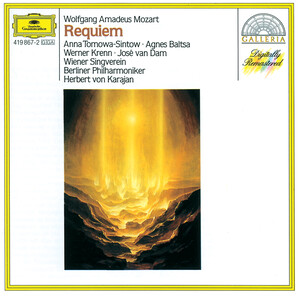
10. Requiem Mass in D Minor (K626)
Wolfgang Amadeus Mozart (1791)
from "Mozart: Requiem In D Minor"
9. Death Is the Road to Awe
Clint Mansell and the Kronos Quartet (2006)
from "The Fountain Soundtrack"
8. God's Gonna Cut You Down
Johnny Cash (2006)
from "American V: A Hundred Highways"
7. When the Levee Breaks
Led Zeppelin (1971)
from "IV"
6. Stardust
Louis Armstrong and the Tommy Dorsey Band (1947)
from "Stardust: Classic Satchmo"
5. Blue In Green
Miles Davis (1959)
from "Kind of Blue"
4. Ain't Too Proud To Beg
The Temptations (1966)
from "Motown 50"
3. Moonlight Mile
The Rolling Stones (1971)
from "Sticky Fingers"
2. Are You Sure Hank Did It This Way
Waylon Jennings (1975)
from "Dreaming My Dreams"
1. Trouble Man
Marvin Gaye (1972)
from "Trouble Man Soundtrack"
--Nickolas Cook
With one of five new books coming out in the next few months, I've been swamped doing edits and finishing the first drafts on some of them. I spend quite a lot of time writing every day and some days are easier than others. One thing I try to do to make it easier to slip into my writing mode is building soundtracks for each of my books. The book which is looming the soonest for release is DEAD DOG, the first in a series of books about a couple of violent good old boys named Max and Little Billy, who live in a small redneck town in Florida, and find themselves in trouble with the local drug czar during an informal investigation into the torture death of a young boy. While this isn't exactly a horror novel, it does deal with horrific elements and some very nasty people. As you can imagine this isn't something I'd like to live inside for that many hours a day--which all told is probably somewhere around 300 hours or more by now. It takes some revving up on some days to get there so I can write an honest narrative.
For DEAD DOG I had to build a soundtrack that reflected what the two main characters would most likely be listening to in their time and place, which in this case was Deep South Florida, circa mid-1970s. Below I'm including the TOP 13 songs on that particular playlist, but I'm also including the url for the complete playlist which I built on YouTube for my listening pleasure when I was online while writing. So here's to hoping you'll enjoy it as much as I have for the past few months, during the writing and editing process of DEAD DOG.
Url link for the complete up to date playlist soundtrack for DEAD DOG: http://www.youtube.com/playlist?list=PLC38FE7D0328CE56D&feature=mh_lolz
(P.S.--DEAD DOG will be coming out with Grand Mal Press, so keep an eye out for it, buy it, read it and let me know what you think.)
13. Since I Don't Have You
The Skyliners (1959)
from the "American Graffiti Soundtrack"
12. Southern Man
Neil Young (1970)
from "After the Gold Rush"
11. Run Through the Jungle
CCR (1970)
from "Cosmo's Factory"
10. Requiem Mass in D Minor (K626)
Wolfgang Amadeus Mozart (1791)
from "Mozart: Requiem In D Minor"
9. Death Is the Road to Awe
Clint Mansell and the Kronos Quartet (2006)
from "The Fountain Soundtrack"
8. God's Gonna Cut You Down
Johnny Cash (2006)
from "American V: A Hundred Highways"
7. When the Levee Breaks
Led Zeppelin (1971)
from "IV"
6. Stardust
Louis Armstrong and the Tommy Dorsey Band (1947)
from "Stardust: Classic Satchmo"
5. Blue In Green
Miles Davis (1959)
from "Kind of Blue"
4. Ain't Too Proud To Beg
The Temptations (1966)
from "Motown 50"
3. Moonlight Mile
The Rolling Stones (1971)
from "Sticky Fingers"
2. Are You Sure Hank Did It This Way
Waylon Jennings (1975)
from "Dreaming My Dreams"
1. Trouble Man
Marvin Gaye (1972)
from "Trouble Man Soundtrack"
--Nickolas Cook
Top 13: Best Horror Films of 1978
compiled by Nickolas Cook
The year was 1978 and drive-ins were still alive and well across the country and horror was still very much in demand (even though, thanks to Star Wars (1977) the science fiction film was definitely taking over). Big studios had taken to making them as well, so there were some big budget films popping up on the radar. But one movie on this list was about to change the face of horror films for decades to come. I'll let you figure out which one it is...and any Horrorhead worth his/her salt will know exactly which film I mean.
It wasn't easy to choose 13 titles out of all the films which came out that year, but I think I found the best of the many which came out in 1978. Some of the films that didn't make the cut are still, in my opinion, well worth searching out and viewing. I mean, you can't go wrong with movies like the Spanish fangs of "Alucarda", squishy laughs from the cult classic "Attack of the Killer Tomatoes", the toothsome sequel "Jaws 2", the somewhat black comedy of "The Boys From Brazil", another better than expected sequel, "Damien: Omen II", thrills in the hospital halls with Robin Cook's bestseller come to the big screen, "Coma", strange happenings with "The Eyes of Laura Mars", even more sequel lovin' from "It Lives Again", a little bit of puppet horror with "Magic", some gory fun with hand tools in "The Toolbox Murders" and even some nature gone wild disaster goodness with Irwin Allen's "The Swarm".
The movies which did make the list all generally wind up on most fans' and critics' genre best of lists, so if you're not familiar with a few of the titles, do yourself a favor: seek them out and educate yourself on what made the grade in the glorious disco lovin' year of 1978. I think it's pretty telling that 6 of the 13 movies on this list have been remade. So, without further ado, behold and enjoy our Top 13 Best Horror Films of 1978
(NOTE: List is in alphabetical order only, not by importance to the genre)
13. Blue Sunshine
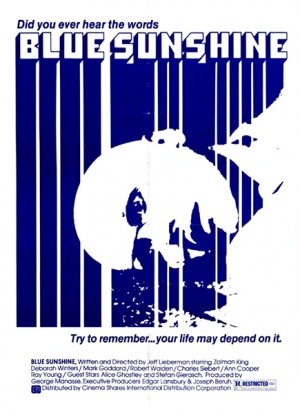
Directed by one of my favorite directors, Jeff Lieberman, who also made a couple of other standout cult classics of the genre, SQUIRM (1976)and JUST BEFORE DAWN (1981), this is a cautionary tale about the eventual cultural backlash of the free-loving 60s flower children movement. The experimental drug Blue Sunshine has some nasty side effects that cause those who imbibed it years earlier to become blood thirsty murdering psychopaths. Lieberman knows what buttons to push by showing us mothers and fathers killing their family and friends, all crazy eyed and bald, and just who do you think was behind all those innocent people ingesting the drug? This is a movie that should be included in any decent horror collection.
12. Dawn of the Dead
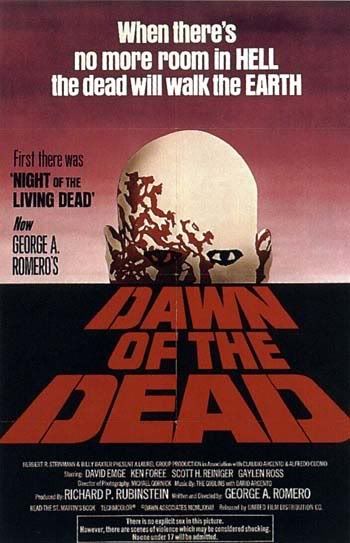
It's no secret by now that this is one of the most influential movies on my life, and I daresay, there are probably millions more people who will agree that this still stands at the top as the best zombie movie ever made. Directed by George Romero, we see the world end as the living are killed and eaten by zombies. It's one of his strongest films, giving a clear warning about the dangers of consumerism gone wild. And after you've seen it, you'll never look at your local shopping mall the same again. The 2004 remake was decent, but nowhere near as powerful as the original.
11. The Fury
Director Brian De Palma had already given us CARRIE (1976) and so he went seeking amongst the bookshelves for more psychokinetic mayhem with this story from John Farris about a couple of young adults who have been created by a secret group of government run scientists to be born with psychic powers, so they can be trained to destroy America's Cold War enemies. It had some real star power with the aging Kirk Douglas as the father of one of the powerful children, but it's really about Amy Irving, who plays the young psychic powered woman, pursued by the government to be used as an assassin. Most people who have seen this will remember the splatter-riffic ending best, but even without that gruesome scene this is a top notch thriller made by one of the genre's greatest directors at the height of his popularity.
10. The Grapes of Death (Les Raisins De La Mort!)
Director Jean Rollin has a way with horror that most international horror makers miss by a huge margin. Using soft focus cinematography and large canvas backdrop scenary, he tells the story of what happens when a small French country community is driven to ghoulism and acts of violence and bloody murder when they drink wine made from grapes that have been sprayed with a new chemical pesticide. The 1970s was a hotbed decade for the dangers of chemicals in foods and drink, and their eventual effect on those who innocently ingested them. But beyond the warning, Rollin gives us a hell of a gory film with moments of tension that match any American made horror film of that period. When you expect he will turn the camera's eye away, he keeps on rolling, allowing us no comfort as the violence escalates. This is as close to a zombie film as you can get without any actual zombies, much like 28 DAYS LATER (2002)
9. Halloween
And if you haven't figured out which film on this list changed the horror genre forever afterwards, this is it. Directed by John Carpenter, this almost singlehandedly gives us the psycho slasher horror film as a true sub-genre. We are given all the slasher tropes in this one film: the holiday as a demarcation period for the slayings, innocent and not so innocent teenagers as knife fodder, the unstoppable killing machine psychopath and the trademark camera setups for "scareshots" or "jumpshots". Without this movie it's almost certain we wouldn't have had such other classic slasher flicks as FRIDAY THE 13th (1981) or PROM NIGHT (1980). "Halloween" remained the number one box office moneymaker in horror, until recent years when THE BLAIR WITCH PROJECT (1999) came along to claim that crown. The recent remake by Rob Zombie in 2007 doesn't hold a candle to the power of the original.
8. Invasion of the Body Snatchers
This is a remake that actually works. Directed by Phillip Kaufman, and starring some of the 70s biggest name actors and actresses, this takes the original film of 1956 and gives another cautionary tale about the eventual reprocutions from the flower child era in America. This time it's a warning against the infiltration of too much liberalism and new age psychological methods in everyday practice. A sort of cry against Socialism, in its own way. But even as a straight forward alien invasion story this movie works very well. It has a damn near perfect balance of titillating shocks and intelligence. I don't know too many people who have seen this movie who don't get creeped out by at least two or three key scenes in it. If you haven't seen the original 1956, do so, but also see this one. The other semi-remakes, such as BODY SNATCHERS (1993), can be ignored.
7. I Spit On Your Grave (aka Day of the Woman)
Truly a "grindhouse" classic, this movie, directed by Meir Zarchi and starring one of the bravest actresses in film, Camille Keaton, this is the ultimate in rape revenge flicks. And let me tell you, this is not for the faint of heart, as the camera never flinches: you see it all. You experience every disgusting, terrifying moment right along with the poor woman who is not only gang raped once, but is gang raped twice by the same group of good old boy backwoods asshole rednecks. Needless to say, no one can blame her for taking her bloody revenge on these bastards. But what really set off the critics and activist groups was how much pleasure she seems to take in luring them into her lair to kill them in inventive and cruelly sadistic ways to match their role in her rapings. This isn't a movie that you want to watch with your parents, for sure, and not to be taken lightly, as it still has the power to shock and disgust like very few modern films. The recent remake from 2010 didn't have anywhere near the punch to the gut of the original. In fact, the original film was banned in many countries, and has remained so in several of them to this day. It became a hotbed for controversy when several censorhip activist groups used it as an example for more governmental content control.
6. The Legacy
Directed by Richard Marquand and starring Katharine Ross, Sam Elliott and "The Who's" Roger Daltrey, this is a supernatural thriller based on a bestselling John Coyne novel of the same name. It takes the Gothic conventions of an inheritance from a mysterious benefactor to the devil in a contemporary setting, in this case, the backroads of modern day England. The pace is fast enough to keep you interested, while also presenting a creepy mystery...you know, actually, I did a great review for the book, which works as well for the movie, here at Amazon.com several years ago. Check it out. Buy the movie and the book. Maybe the author will come back to horror again, instead of his current well received pro golf books.
5. Long Weekend
One of two Austrialian films that made the list, this is the ultimate in cautionary tales about exploitation of the natural world. A young couple take a weekend on a deserted beach front property and spend their time abusing the hell out of the place, shooting the animals, throwing their garbage wherever they feel like... but seems Mother Nature isn't willing to put up with it this time and sends the elements and the indigenous creatures to exact revenge. The story sounds simple, but the way in which their abuse of the natural world mirrors their loathing for each other and themselves is what makes the movie work best. There was a recent remake of this movie in 2008 that didn't work as well because it didn't keep that subtext.
4. The Manitou
This is one of the greatest cheesy movies ever made. Directed by the late great William Girdler, who tragically died before the release of this, his most popular film to date, and starring Tony Curtis and Burgess Meredith, it was based on the book of the same name by one of horror fiction's grandmasters, Graham Masterton. It was a hell of a great read that was turned into a hell of a great movie. When Susan Strasberg discovers a strange growth on the back of her neck that keeps getting bigger and bigger, she is hospitalized for testing. But the growth isn't just a tumor, but the ancient spirit of an evil Indian shaman who is using her as a physical channel by which to be reborn. Although you'll most likely laugh at the now dated early animation effects, it's the makeup effects that work best in giving the midget demon a sense of true menace as he gains control of the woman and then the hospital while Tony Curtis' fake psychic must battle a real supernatural danger with the help of his hired Indian shaman, played by Michael Ansara. I saw this as a kid and have never forgotten how much fun it was to watch. I still dig this movie, even today, all these years later.
3. Patrick
The other Australian flick on our list was directed by the late great Richard Franklin, who was one of that country's greatest genre directors, who also made another horror classic, ROAD GAMES (1981). "Patrick" is the story of a young man who murders his parents and goes into a coma, but that coma doesn't stop him from using his psychic powers to manipulate his environment. And when he falls in love with his new nurse, he uses his powers to make her life a living nightmare. Known for its pacing and special effects, there's another reason for Horrorheads everywhere to love this one: the Italian prog-rock horror soundtrack gods "Goblin" did the original soundtrack, although later reissues have a different soundtrack by Brian May of "Queen".
2. Piranha
Remade last year as a 3-D film, this original was directed by Joe Dante from a blackly humorous screenplay by the great John Sayle, and it's still one hell of fun movie. It's sort of a throwback to the 50s style monster on the loose films that these guys grew up on, but it still has enough gore to satisfy modern audiences, with enough humor to keep it light and fun, as it tells the story of a summer camp resort under seige from a new genetically bred killer school of piranha that are out for blood. There's even a small role for Barbara Steele, but look for other great sight gags and cameos from horrors legends. If you like the remake, then this original will probably be just as entertaining for you.
1. The Shout
This is probably the least known film on this list and that's a damned shame, because this is a great low key creepy horror film, with some great acting from some of the U.K.'s greatest names, John Hurt, Alan Bates, Tim Curry and Susannah York. It was a winner that year at the Cannes Film Festival and for good reason: it is a damned great little movie. Alan Bates is a mysterious stranger who insinuates himself into the quiet country life of John Hurt and Susannah York, who tells them he has been taught by ancient shaman how to use his voice to kill. Based on a short story by one of modern fiction's greatest writers, Robert Graves, this movie has literary intelligence and insight into the human condition, while still being frightening on different levels than most horror cinema can hope to accomplish. Much of the disquieting sense comes from the use of camera and the sound effects and musical score. If you've never seen this one, it is a must.
--Nickolas Cook
The year was 1978 and drive-ins were still alive and well across the country and horror was still very much in demand (even though, thanks to Star Wars (1977) the science fiction film was definitely taking over). Big studios had taken to making them as well, so there were some big budget films popping up on the radar. But one movie on this list was about to change the face of horror films for decades to come. I'll let you figure out which one it is...and any Horrorhead worth his/her salt will know exactly which film I mean.
It wasn't easy to choose 13 titles out of all the films which came out that year, but I think I found the best of the many which came out in 1978. Some of the films that didn't make the cut are still, in my opinion, well worth searching out and viewing. I mean, you can't go wrong with movies like the Spanish fangs of "Alucarda", squishy laughs from the cult classic "Attack of the Killer Tomatoes", the toothsome sequel "Jaws 2", the somewhat black comedy of "The Boys From Brazil", another better than expected sequel, "Damien: Omen II", thrills in the hospital halls with Robin Cook's bestseller come to the big screen, "Coma", strange happenings with "The Eyes of Laura Mars", even more sequel lovin' from "It Lives Again", a little bit of puppet horror with "Magic", some gory fun with hand tools in "The Toolbox Murders" and even some nature gone wild disaster goodness with Irwin Allen's "The Swarm".
The movies which did make the list all generally wind up on most fans' and critics' genre best of lists, so if you're not familiar with a few of the titles, do yourself a favor: seek them out and educate yourself on what made the grade in the glorious disco lovin' year of 1978. I think it's pretty telling that 6 of the 13 movies on this list have been remade. So, without further ado, behold and enjoy our Top 13 Best Horror Films of 1978
(NOTE: List is in alphabetical order only, not by importance to the genre)
13. Blue Sunshine
Directed by one of my favorite directors, Jeff Lieberman, who also made a couple of other standout cult classics of the genre, SQUIRM (1976)and JUST BEFORE DAWN (1981), this is a cautionary tale about the eventual cultural backlash of the free-loving 60s flower children movement. The experimental drug Blue Sunshine has some nasty side effects that cause those who imbibed it years earlier to become blood thirsty murdering psychopaths. Lieberman knows what buttons to push by showing us mothers and fathers killing their family and friends, all crazy eyed and bald, and just who do you think was behind all those innocent people ingesting the drug? This is a movie that should be included in any decent horror collection.
12. Dawn of the Dead
It's no secret by now that this is one of the most influential movies on my life, and I daresay, there are probably millions more people who will agree that this still stands at the top as the best zombie movie ever made. Directed by George Romero, we see the world end as the living are killed and eaten by zombies. It's one of his strongest films, giving a clear warning about the dangers of consumerism gone wild. And after you've seen it, you'll never look at your local shopping mall the same again. The 2004 remake was decent, but nowhere near as powerful as the original.
11. The Fury
Director Brian De Palma had already given us CARRIE (1976) and so he went seeking amongst the bookshelves for more psychokinetic mayhem with this story from John Farris about a couple of young adults who have been created by a secret group of government run scientists to be born with psychic powers, so they can be trained to destroy America's Cold War enemies. It had some real star power with the aging Kirk Douglas as the father of one of the powerful children, but it's really about Amy Irving, who plays the young psychic powered woman, pursued by the government to be used as an assassin. Most people who have seen this will remember the splatter-riffic ending best, but even without that gruesome scene this is a top notch thriller made by one of the genre's greatest directors at the height of his popularity.
10. The Grapes of Death (Les Raisins De La Mort!)
Director Jean Rollin has a way with horror that most international horror makers miss by a huge margin. Using soft focus cinematography and large canvas backdrop scenary, he tells the story of what happens when a small French country community is driven to ghoulism and acts of violence and bloody murder when they drink wine made from grapes that have been sprayed with a new chemical pesticide. The 1970s was a hotbed decade for the dangers of chemicals in foods and drink, and their eventual effect on those who innocently ingested them. But beyond the warning, Rollin gives us a hell of a gory film with moments of tension that match any American made horror film of that period. When you expect he will turn the camera's eye away, he keeps on rolling, allowing us no comfort as the violence escalates. This is as close to a zombie film as you can get without any actual zombies, much like 28 DAYS LATER (2002)
9. Halloween
And if you haven't figured out which film on this list changed the horror genre forever afterwards, this is it. Directed by John Carpenter, this almost singlehandedly gives us the psycho slasher horror film as a true sub-genre. We are given all the slasher tropes in this one film: the holiday as a demarcation period for the slayings, innocent and not so innocent teenagers as knife fodder, the unstoppable killing machine psychopath and the trademark camera setups for "scareshots" or "jumpshots". Without this movie it's almost certain we wouldn't have had such other classic slasher flicks as FRIDAY THE 13th (1981) or PROM NIGHT (1980). "Halloween" remained the number one box office moneymaker in horror, until recent years when THE BLAIR WITCH PROJECT (1999) came along to claim that crown. The recent remake by Rob Zombie in 2007 doesn't hold a candle to the power of the original.
8. Invasion of the Body Snatchers
This is a remake that actually works. Directed by Phillip Kaufman, and starring some of the 70s biggest name actors and actresses, this takes the original film of 1956 and gives another cautionary tale about the eventual reprocutions from the flower child era in America. This time it's a warning against the infiltration of too much liberalism and new age psychological methods in everyday practice. A sort of cry against Socialism, in its own way. But even as a straight forward alien invasion story this movie works very well. It has a damn near perfect balance of titillating shocks and intelligence. I don't know too many people who have seen this movie who don't get creeped out by at least two or three key scenes in it. If you haven't seen the original 1956, do so, but also see this one. The other semi-remakes, such as BODY SNATCHERS (1993), can be ignored.
7. I Spit On Your Grave (aka Day of the Woman)
Truly a "grindhouse" classic, this movie, directed by Meir Zarchi and starring one of the bravest actresses in film, Camille Keaton, this is the ultimate in rape revenge flicks. And let me tell you, this is not for the faint of heart, as the camera never flinches: you see it all. You experience every disgusting, terrifying moment right along with the poor woman who is not only gang raped once, but is gang raped twice by the same group of good old boy backwoods asshole rednecks. Needless to say, no one can blame her for taking her bloody revenge on these bastards. But what really set off the critics and activist groups was how much pleasure she seems to take in luring them into her lair to kill them in inventive and cruelly sadistic ways to match their role in her rapings. This isn't a movie that you want to watch with your parents, for sure, and not to be taken lightly, as it still has the power to shock and disgust like very few modern films. The recent remake from 2010 didn't have anywhere near the punch to the gut of the original. In fact, the original film was banned in many countries, and has remained so in several of them to this day. It became a hotbed for controversy when several censorhip activist groups used it as an example for more governmental content control.
6. The Legacy
Directed by Richard Marquand and starring Katharine Ross, Sam Elliott and "The Who's" Roger Daltrey, this is a supernatural thriller based on a bestselling John Coyne novel of the same name. It takes the Gothic conventions of an inheritance from a mysterious benefactor to the devil in a contemporary setting, in this case, the backroads of modern day England. The pace is fast enough to keep you interested, while also presenting a creepy mystery...you know, actually, I did a great review for the book, which works as well for the movie, here at Amazon.com several years ago. Check it out. Buy the movie and the book. Maybe the author will come back to horror again, instead of his current well received pro golf books.
5. Long Weekend
One of two Austrialian films that made the list, this is the ultimate in cautionary tales about exploitation of the natural world. A young couple take a weekend on a deserted beach front property and spend their time abusing the hell out of the place, shooting the animals, throwing their garbage wherever they feel like... but seems Mother Nature isn't willing to put up with it this time and sends the elements and the indigenous creatures to exact revenge. The story sounds simple, but the way in which their abuse of the natural world mirrors their loathing for each other and themselves is what makes the movie work best. There was a recent remake of this movie in 2008 that didn't work as well because it didn't keep that subtext.
4. The Manitou
This is one of the greatest cheesy movies ever made. Directed by the late great William Girdler, who tragically died before the release of this, his most popular film to date, and starring Tony Curtis and Burgess Meredith, it was based on the book of the same name by one of horror fiction's grandmasters, Graham Masterton. It was a hell of a great read that was turned into a hell of a great movie. When Susan Strasberg discovers a strange growth on the back of her neck that keeps getting bigger and bigger, she is hospitalized for testing. But the growth isn't just a tumor, but the ancient spirit of an evil Indian shaman who is using her as a physical channel by which to be reborn. Although you'll most likely laugh at the now dated early animation effects, it's the makeup effects that work best in giving the midget demon a sense of true menace as he gains control of the woman and then the hospital while Tony Curtis' fake psychic must battle a real supernatural danger with the help of his hired Indian shaman, played by Michael Ansara. I saw this as a kid and have never forgotten how much fun it was to watch. I still dig this movie, even today, all these years later.
3. Patrick
The other Australian flick on our list was directed by the late great Richard Franklin, who was one of that country's greatest genre directors, who also made another horror classic, ROAD GAMES (1981). "Patrick" is the story of a young man who murders his parents and goes into a coma, but that coma doesn't stop him from using his psychic powers to manipulate his environment. And when he falls in love with his new nurse, he uses his powers to make her life a living nightmare. Known for its pacing and special effects, there's another reason for Horrorheads everywhere to love this one: the Italian prog-rock horror soundtrack gods "Goblin" did the original soundtrack, although later reissues have a different soundtrack by Brian May of "Queen".
2. Piranha
Remade last year as a 3-D film, this original was directed by Joe Dante from a blackly humorous screenplay by the great John Sayle, and it's still one hell of fun movie. It's sort of a throwback to the 50s style monster on the loose films that these guys grew up on, but it still has enough gore to satisfy modern audiences, with enough humor to keep it light and fun, as it tells the story of a summer camp resort under seige from a new genetically bred killer school of piranha that are out for blood. There's even a small role for Barbara Steele, but look for other great sight gags and cameos from horrors legends. If you like the remake, then this original will probably be just as entertaining for you.
1. The Shout
This is probably the least known film on this list and that's a damned shame, because this is a great low key creepy horror film, with some great acting from some of the U.K.'s greatest names, John Hurt, Alan Bates, Tim Curry and Susannah York. It was a winner that year at the Cannes Film Festival and for good reason: it is a damned great little movie. Alan Bates is a mysterious stranger who insinuates himself into the quiet country life of John Hurt and Susannah York, who tells them he has been taught by ancient shaman how to use his voice to kill. Based on a short story by one of modern fiction's greatest writers, Robert Graves, this movie has literary intelligence and insight into the human condition, while still being frightening on different levels than most horror cinema can hope to accomplish. Much of the disquieting sense comes from the use of camera and the sound effects and musical score. If you've never seen this one, it is a must.
--Nickolas Cook
Subscribe to:
Posts (Atom)